Showing posts with label dolphin watching tours. Show all posts

Saturday, April 14, 2007

Sarawak’s Draft Marine Mammal Watching Guidelines

Sarawak now has a draft set of guidelines for marine mammal watching. As I’ve argued before such guidelines are long overdue. The need to develop dolphin watching guidelines for Sarawak was first brought to the attention of the Ministry of Tourism and Sarawak Forest Department in 2002 when the Sarawak Tourist Association raised the matter. The idea then was to develop guidelines through a consultative process involving the tourism industry via workshops and practical training for boatmen. At that time the Forest Department was not even aware that tour operators and boat owners were conducting dolphin watching tours even though these tours had been running for years. Nothing came of the proposal. Anyway, fast forward 5 years and it seems that the relevant wildlife agency is now taking an interest in Sarawak’s nascent dolphin watching industry which should be a good thing.

Last month members of the tourism industry and government sector were invited to a presentation by the Sarawak Forestry Corporation (SFC), the agency currently responsible for wildlife management in the state. SFC gave a presentation on the wider actitives of SFC and then the marine mammal watching guidelines. This was the first time the tourism industry were aware of the guidelines as tourism operators were not consulted in the process of developing the draft guidelines. A number of operators and boat owners that offer dolphin watching tours were not at the meeting and many of those at the meeting do not even offer dolphin watching tours in Sarawak. This week I did a quick check amongst existing operators and many are not aware that there is now a draft set of dolphin watching guidelines.

So how useful are the guidelines and how relevant are they to Sarawak? Well first off the guidelines have not been specifically tailored to suit Sarawak’s dolphin watching industry which is currently focused on the Irrawaddy dolphin. In fact Sarawak’s guidelines are copied almost word-for-word from the Australian National Guidelines for Whale and Dolphin Watching. Yes, someone at SFC has done a ‘cut and paste’ job. On the printed copy of the Sarawak guidelines, there is no acknowledgement of the fact the guidelines were lifted from the Australian regulations.

Using the Australian guidelines as a model for Sarawak is not a bad thing. However, I think greater effort should have been made to adapt the Australian guidelines to the local Sarawak setting. In addition the local tourism industry should have been consulted more and given the chance to provide some meaningful input. According to people that were at last month’s presentation, some wildlife officials were not very well briefed on the local dolphin watching industry.

Currently all dolphin watching tours in Sarawak take place in rivers and estuaries not in the open ocean. However, the guidelines allocate just two sentences to confined waterways.

In confined or crowded waterways such as bays, estuaries, channels and rivers it may not be possible for vessels to maintain approach distances or appropriate number of boat within the caution zone. In these instances take all necessary caution to avoid whales and dolphins.

So just 44 words of the 17 page document are directly relevant to Sarawak’s existing dolphin watching industry. In this respect, the guidelines essentially boil down to last sentence “in these instances take all necessary caution to avoid whales and dolphins”. Which basically amounts to “its up to you lah”!

Many aspects of the guidelines are more relevant to Australia than Sarawak. This is hardly surprisingly since the guidelines were copied from Australia. For example there is a section on land based marine mammal watching that states “cliffs and headlands can provide excellent advantage points for viewing many different whale and dolphins” Does anyone out there know of any cliffs or headlands on Sarawak’s low lying coastline? Last time I looked most of Sarawak’s coast was as flat as pancake. There may be the odd cliff here and there but most of these overlook shallow waters. You’d have to camp out on a cliff for a few years before you catch sight of a whale or dolphin.

There is also a whole bunch of stuff in the guidelines on feeding and dolphin swimming programmes, again lifted directly form the Australian guidelines. These sections state that feeding and dolphin swim programmes are not allowed unless authorised by SFC. I think it would have been better to state that feeding and swim programmes are banned, period. Australia has a pretty good licensing and monitoring system for feeding and swim programmes. In contrast there is limited enforcement and monitoring of conservation and wildlife regulations in Sarawak. In view of the limited resources allocated to monitoring and enforcement I think no authorisation should be given for feeding and swim programmes.

With regards to dolphin swim programmes, there is also a safety concern in Sarawak. In many places swimming with dolphin programmes are not viable in Sarawak. The accessible dolphin populations are found in rivers and estuaries where crocodiles are also commonly found. Not sure too many tourists would fancy swimming with dolphins with a bunch of crocs lurking nearby?

All in all the draft guidelines are a bit disappointing. Not much work has gone into them, they have just been copied from elsewhere. In their current form the guidelines are not going to have much impact. Hopefully there will be more discussion, debate and consultation so that the existing draft can be adapted to local conditions.

Thursday, March 22, 2007

Male Proboscis Monkey


I haven’t been dolphin watching for a while, hence the lack of posts. But I have managed a few trips to Sarawak’s national parks including Lambir, Kuching Wetlands, Similajau and Bako. This picture was taken at Bako on Monday. Bako and Kuching Wetlands are the best places for seeing proboscis monkeys in Sarawak. If you go an afternoon dolphin watching trip at Santubong and tag on a mangrove or wildlife cruise there is a pretty good chance of seeing proboscis monkeys in the nearby Kuching Wetlands National Park. And what wonderful creatures they are.

Saturday, July 15, 2006

New Pamphlet on Sarawak's Irrawaddy Dolphins


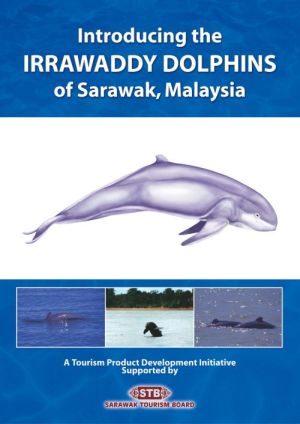
The Sarawak Tourism Board recently published a pamphlet on Sarawak’s Irrawaddy dolphins as part of a product development initiative related to the state’s dolphin watching industry. The pamphlet will be given out to tourists who participate in dolphin watching tours. It contains a fact file on the Irrawaddy dolphin with information on habitat, distribution, appearance, behaviour, diet, reproduction, group size, and an overview of the various conservation threats faced by the dolphins. It also discusses association with local fisherman, where to go dolphin watching and provides brief details about other marine mammals of Sarawak. The general idea is to improve on-board interpretation so that tourists can learn more about the dolphins.

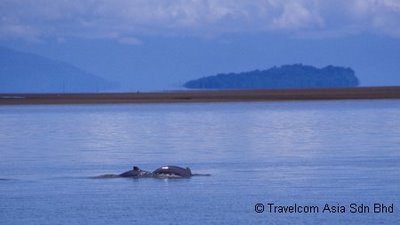
The pamphlet also contains a range of photos taken at Santubong, Salak, Sibu Laut and Buntal. Many of these photos first appeared in this blog. The back page image by Chien Lee was featured here in May.
So, if you are in town and plan to go dolphin watching ask for a copy of the pamphlet.

Sunday, April 02, 2006

Dolphin Watching in Sarawak, Where to Go

The best locations near Kuching for watching Irrawaddy dolphins are Santubong, Salak and Buntal. These are the areas where tour operators generally go to. CPH Travel knows the Santubong and Salak areas very well, whilst Ehwan focuses on tours around Buntal, his home village.

Other areas where Irrawaddy dolphins can be spotted near Kuching include the waters around Bako National Park (keep an eye out when you travel by boat from Kampung Bako to the park HQ); Kuala Sibu Laut, although sightings are not that common, and Muara Tebas, a pretty good area but its not easy to just turn up and rent a boat, especially one that comes with a good guide-cum spotter.

For a map of the Kuching region, see
www.borneotravel.com/web/map_regi.pdf

Further a field there are a number of areas where Irrawaddy dolphins are frequently spotted. Tanjung Manis, a port area near Sarikei, is highly developed and has heavy boat traffic, but dolphins are still found there. Best way to get to Sarikei is by express boat from Kuching. There are a lot of sightings of Irrawaddy dolphins in the Saribas area, especially between Beladin and Pusa. Pusa is about 300 kilometres from Kuching.

Whilst Irrawaddy dolphins are often sighted at Tanjung Manis and Saribas it is not easy to arrange a trip to see them. No tour operators or local boat owners offer trips in these areas. Basically you just have to turn up, talk to local fishermen and see if they want to rent you a boat for an exploratory dolphin watching trip. If you live near these areas then it might be worth trying, for foreign tourists the best bet is to go dolphin watching at Santubong, Salak or Buntal.

Dolphin Watching in Sarawak, Who to Go With


Currently there are only two operators in the Kuching area that regularly conduct dolphin watching tours. These are tour operator CPH Travel and boat owner Ehwan Ibrahim from Kampung Buntal. Both are experienced at locating and approaching Irrawaddy dolphins. If you are going on a dolphin watching tour, bear in mind that Irrawaddys are not the easiest of dolphins to spot. They are shy and only appear on the surface very briefly. Sightings are not guaranteed so you might want to combine dolphin watching with another marine tour, for example a mangrove cruise. That way you are guaranteed to see some wildlife, even if you don’t see a dolphin.

CPH Travel pioneered dolphin watching tours in Sarawak. They first offered the tours in 1998. They have a range of modern boats and their boatmen are good dolphin spotters. Most of CPH’s boatmen come from the fishing villages in the Santubong area. CPH’s dolphin watching tours focus on the Santubong estuary. Tours depart from the Santubong boat club, just 5-10 minutes away from the areas where dolphins are commonly spotted.

In addition to offering dedicated dolphin watching tours, CPH offer a range of marine tours including mangrove and wildlife cruises, trips to the Kuching Wetlands National Park, snorkelling trips to Satang Island and full day boat cruises that take in all the attractions of the wider Santubong area. Most of CPH’s marine tours incorporate some dolphin watching but this is not the primary focus of the tours.

One of CPH’s most popular trips is the Santubong Wildlife Cruise which departs around 4 pm and returns around 7.30 pm. First you go in search of Irrawaddy dolphins in the Santubong estuary; then you head upriver to check out the mangroves and wildlife (with good chances of seeing proboscis monkeys). As darkness falls you go in search of crocodiles, using flashlights to locate the croc’s eye shine.

CPH Travel, 70 Padungan Road
93100 Kuching, Sarawak, Malaysia
Tel: 082-242289 Email: cphtrvl@po.jaring.my
www.cphtravel.com.my

Ehwan bin Ibrahim is a boat owner from Buntal. A former fisherman, he started offering mangrove and wildlife tours in and around the Buntal area about 6 years ago. He has two fibreglass boats; both can take a maximum of 6 people. Ehwan uses boatmen from his village, although sometimes he runs the tour himself.

As the Bako-Buntal bay is a wider stretcher of water than the Santubong estuary, the chances of seeing dolphins are perhaps not as high as Santubong as you have to cover a wider area. But during hide tide the dolphins sometimes enter the Buntal River itself, offering great opportunities to view and photograph the dolphins.

Ehwan will usually combine dolphin watching with a mangrove/wildlife tour. You first head out of the village into the estuary to search for Irrawaddy dolphins, if they are not around the boat turns back and enters the Buntal river. You then go in search of wildlife such as silver-leaf monkeys, macaques, proboscis monkeys, estuarine crocodiles and whole range of birdlife. All the time your get to see life in the bay and the river, with fishing craft coming and going and heaps going on.

Ehwan is quite flexible. Tell him what you want to see and do and he’ll tailor the boat cruise to you requirements. The good thing about Ehwan’s tours is that you get to immerse yourself in Kampung life as well. After a tour you can have a stroll round Buntal village, or sit down and have a chat with Ehwan and his mates. Ehwan’s wife Serimah also bakes some of the best Malay-style layer cakes in Sarawak so you can even stuff your face with cakes after your trip.

Ehwan Ibrahim
No. 211, Kampung Buntal, Sarawak, Malaysia.
Tel: 082-846977 or 019-8785088

Ehwan’s house is opposite the 88 Seafood Restaurant, just before the village’s market area.

Finally, a word of warning. Over the last year or so a number of other tour operators in Kuching have started to market dolphin watching tours, or at least claim that they do. Some of these operators use CPH or Ehwan so essentially act as booking agents. However, some use inexperienced boatmen and guides-cum-spotters who do not know how to approach dolphins properly. Sad to say but many of these operators are clueless. One even advertises Irrawaddy dolphin tours by using a photo of a Spinner Dolphin! Whilst you may see dolphins on these trips, your chances of success are less than if you use the more experienced and responsible operators/boat owners.


Dolphin Watching in Sarawak, When to Go


Sarawak’s dolphin watching season runs from April to November, basically during the dry season months. Whilst the Irrawaddy dolphins are around during the wet season, the sea conditions often prevent boats from going out to sea. Even if you can go out the swell and rain often make it difficult to spot dolphins. Irrawaddy dolphins only surface briefly so if the water is choppy you often miss the surfacing behaviour. Some years the wet season will end in February so it is possible to go out in March. Likewise if the rainy season comes late it is sometimes possible to go out in December.

Thursday, March 30, 2006

Tips on taking photos and video of Irrawaddy dolphins


Irrawaddy dolphins are not the easiest of dolphins to photograph or film. They are fairly inactive and don’t ‘perform’ for the camera like bottlenose or other oceanic dolphins. So here are a few tips that hopefully will increase your chances of getting a good photo of an Irrawaddy.

1. Make sure you go on a dolphin watching tour with an experienced boatman or tour operator. Currently there are only two operators that are experienced at locating and approaching dolphins - CPH Travel and boat owner Ehrwan from Kampung Buntal.

2. You’ll need at least a 300 mm lens to get a good full frame shot. Saying that if you have a good interaction you may be able to get some good shots with a point and push camera. If you are shooting video, priority number one is to turn off the digital zoom. When you spot a group of Irrawaddys keep the tape running rather than turning the camera on and off. If the dolphins disappear, pick a spot and keep the tape running for while. You might get lucky and capture the dolphins surfacing.

3. Help each other to spot the dolphins. If you see a dolphin tell others on the boat where it is. Rather than saying “over there”, “dolphin”, “this side” or other phrases that don’t indicate the direction, use a clock system as a simple reference tool. 12 O’clock is the front of the boat (the bow for the nautically minded), 6 O’clock is the back (stern) of the boat and so on. If you see a dolphin call out its position (1 O’clock , 10 O’clock, etc) so other people on the boat know where it is.
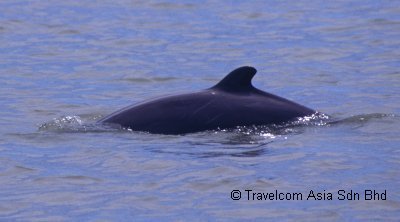
4. Bear in mind that when Irrawaddy dolphins surface they show very little of their body. A normal surface consists of a loud blow and 1-3 quick ‘rolls’, with the dolphin’s head pretty much tucked under water. So you have to be quick. If the dolphins hang around for a while you’ll quickly get the hang of things. If you are able to get a good photo, chances are it will be of this classic roll-like surfacing behaviour.


5. Your chances of taking a good photo are vastly improved if you chance upon a larger group. Yeah I know that’s not exactly rocket science but realistically if you see a small group of 2-4 Irrawaddy dolphins you are better off enjoying the moment rather than getting stressed out trying to take a good photo.

6. If the group you are watching are moving in one direction it is common to miss the first ‘surface’. You hear the ‘blow’, turn round and by the time you click your camera the dolphin is gone. Don’t worry about this and don’t start cursing your bad fortune, you need to keep focused as this may be your chance. Keep the camera directed in roughly the same spot as where the first dolphin surfaced as often a second dolphin or group of dolphins will surface in the same general area, moving in the same direction as the first dolphin.

7. Once you’ve spotted a group try to keep a track of the time between surfaces. Irrawaddy dolphins stay under water for 1-8 minutes, longer if they are scared. So time the surfaces. If the dolphins are surfacing at regular periods (say every 2-3 minutes) then get ready for them.

8. Association with fishing boats. It is quite common to see Irrawaddy dolphins circling small fishing boats. After the fishermen haul in their nets they sort out the fish that they can not sell and throw this ‘trash’ fish back into the sea. This is a good opportunity to get a photo as the situation is more predictable. You can see when the fisherman is about to throw the fish back into the sea and have a good idea where the dolphin will surface.

9. If you are lucky you may observe a dolphin spy hopping (the dolphin pokes its head out of the water and has a good look around). This does not last for long and is usually over in a few seconds, so you have to be quick if you want to get a picture. Occasionally you may see a group gather on the surface and splash around bit, sometimes slapping their fins at each other. This social interaction provides a good opportunity to get a photo as the dolphins are on the surface for longer than usual.

10. So any chances of getting lucky and photographing something special? Well the ultimate would be to capture an Irrawaddy dolphin breaching, jumping clear out of the water. But to photograph this you have to see it and the chances are slim. I’ve only seen an Irrawaddy dolphin jump out of the water on three occasions. Two of these were low horizontal leaps where part of the dolphin was still in the water. But the third was a full breach. I didn’t manage to capture this on film as I was too late and ended up with a photo of a big splash but no dolphin. But a good friend of mine Stuart Green got the shot and captured the early part of the jump. And he knew it at the time; even during the excitement of the moment, he knew he had the shot.