Showing posts with label tourism. Show all posts

Saturday, April 14, 2007

Sarawak’s Draft Marine Mammal Watching Guidelines

Sarawak now has a draft set of guidelines for marine mammal watching. As I’ve argued before such guidelines are long overdue. The need to develop dolphin watching guidelines for Sarawak was first brought to the attention of the Ministry of Tourism and Sarawak Forest Department in 2002 when the Sarawak Tourist Association raised the matter. The idea then was to develop guidelines through a consultative process involving the tourism industry via workshops and practical training for boatmen. At that time the Forest Department was not even aware that tour operators and boat owners were conducting dolphin watching tours even though these tours had been running for years. Nothing came of the proposal. Anyway, fast forward 5 years and it seems that the relevant wildlife agency is now taking an interest in Sarawak’s nascent dolphin watching industry which should be a good thing.

Last month members of the tourism industry and government sector were invited to a presentation by the Sarawak Forestry Corporation (SFC), the agency currently responsible for wildlife management in the state. SFC gave a presentation on the wider actitives of SFC and then the marine mammal watching guidelines. This was the first time the tourism industry were aware of the guidelines as tourism operators were not consulted in the process of developing the draft guidelines. A number of operators and boat owners that offer dolphin watching tours were not at the meeting and many of those at the meeting do not even offer dolphin watching tours in Sarawak. This week I did a quick check amongst existing operators and many are not aware that there is now a draft set of dolphin watching guidelines.

So how useful are the guidelines and how relevant are they to Sarawak? Well first off the guidelines have not been specifically tailored to suit Sarawak’s dolphin watching industry which is currently focused on the Irrawaddy dolphin. In fact Sarawak’s guidelines are copied almost word-for-word from the Australian National Guidelines for Whale and Dolphin Watching. Yes, someone at SFC has done a ‘cut and paste’ job. On the printed copy of the Sarawak guidelines, there is no acknowledgement of the fact the guidelines were lifted from the Australian regulations.

Using the Australian guidelines as a model for Sarawak is not a bad thing. However, I think greater effort should have been made to adapt the Australian guidelines to the local Sarawak setting. In addition the local tourism industry should have been consulted more and given the chance to provide some meaningful input. According to people that were at last month’s presentation, some wildlife officials were not very well briefed on the local dolphin watching industry.

Currently all dolphin watching tours in Sarawak take place in rivers and estuaries not in the open ocean. However, the guidelines allocate just two sentences to confined waterways.

In confined or crowded waterways such as bays, estuaries, channels and rivers it may not be possible for vessels to maintain approach distances or appropriate number of boat within the caution zone. In these instances take all necessary caution to avoid whales and dolphins.

So just 44 words of the 17 page document are directly relevant to Sarawak’s existing dolphin watching industry. In this respect, the guidelines essentially boil down to last sentence “in these instances take all necessary caution to avoid whales and dolphins”. Which basically amounts to “its up to you lah”!

Many aspects of the guidelines are more relevant to Australia than Sarawak. This is hardly surprisingly since the guidelines were copied from Australia. For example there is a section on land based marine mammal watching that states “cliffs and headlands can provide excellent advantage points for viewing many different whale and dolphins” Does anyone out there know of any cliffs or headlands on Sarawak’s low lying coastline? Last time I looked most of Sarawak’s coast was as flat as pancake. There may be the odd cliff here and there but most of these overlook shallow waters. You’d have to camp out on a cliff for a few years before you catch sight of a whale or dolphin.

There is also a whole bunch of stuff in the guidelines on feeding and dolphin swimming programmes, again lifted directly form the Australian guidelines. These sections state that feeding and dolphin swim programmes are not allowed unless authorised by SFC. I think it would have been better to state that feeding and swim programmes are banned, period. Australia has a pretty good licensing and monitoring system for feeding and swim programmes. In contrast there is limited enforcement and monitoring of conservation and wildlife regulations in Sarawak. In view of the limited resources allocated to monitoring and enforcement I think no authorisation should be given for feeding and swim programmes.

With regards to dolphin swim programmes, there is also a safety concern in Sarawak. In many places swimming with dolphin programmes are not viable in Sarawak. The accessible dolphin populations are found in rivers and estuaries where crocodiles are also commonly found. Not sure too many tourists would fancy swimming with dolphins with a bunch of crocs lurking nearby?

All in all the draft guidelines are a bit disappointing. Not much work has gone into them, they have just been copied from elsewhere. In their current form the guidelines are not going to have much impact. Hopefully there will be more discussion, debate and consultation so that the existing draft can be adapted to local conditions.

Saturday, July 15, 2006

New Pamphlet on Sarawak's Irrawaddy Dolphins


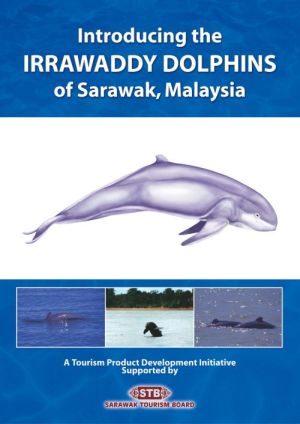
The Sarawak Tourism Board recently published a pamphlet on Sarawak’s Irrawaddy dolphins as part of a product development initiative related to the state’s dolphin watching industry. The pamphlet will be given out to tourists who participate in dolphin watching tours. It contains a fact file on the Irrawaddy dolphin with information on habitat, distribution, appearance, behaviour, diet, reproduction, group size, and an overview of the various conservation threats faced by the dolphins. It also discusses association with local fisherman, where to go dolphin watching and provides brief details about other marine mammals of Sarawak. The general idea is to improve on-board interpretation so that tourists can learn more about the dolphins.

The pamphlet also contains a range of photos taken at Santubong, Salak, Sibu Laut and Buntal. Many of these photos first appeared in this blog. The back page image by Chien Lee was featured here in May.
So, if you are in town and plan to go dolphin watching ask for a copy of the pamphlet.

Sunday, April 23, 2006

Irresponsible Tourism in Action


As I’ve mentioned before, a number of ‘copy-cat’ operators have started to offer dolphin watching tours at Santubong and many of these are not very knowledgeable. I’d heard about a blue boat that regularly harasses the dolphins, chasing them around the bay.

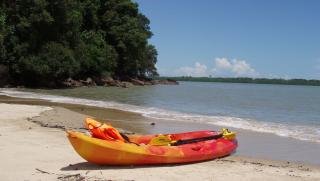
On Saturday 22nd April after kayaking to Salak village, FH20 and I paddled back to the river estuary and encountered three groups of Irrawaddy dolphins. We stopped paddling and just sat in the kayak watching the dolphins surface nearby.

We then spotted a tourist boat some distance away watching another group of dolphins. Both of us were shocked at what we saw. It was the infamous blue boat, the very same boat that responsible dolphin watching operators have expressed concern about.

I could not believe what this boat was doing. The boatman was driving the boat directly towards the group, not parallel to the group, but straight towards the direction the group was swimming. This action split the group up and they moved on, surfacing some distance away from the boat. The boatman then repeated the action, moving at speed towards the group and splitting the group up again. The boat was clearing disturbing the dolphins.

As the boat was off in the distance there was nothing we could do so we carried on watching the groups near us and hoped the boat would not come near us. We remained in the same spot in the river with the three groups surfacing around us. Three dolphins swam towards the kayak and passed just metres away. Another group were socialising on the surface of the water 30 metres away. The different groups then came together in the same area and we just sat there enjoying the experience. But it wasn’t to last.

We heard the loud noise of a boat approaching at speed. We turned around and saw the blue boat speeding towards the group of dolphins which were now 40 metres from our kayak. We were livid as we watched the boat motor towards the group of dolphins. We shouted to the boatman to slow down and keep its distance but the boat drove straight into the combined group. The three groups of dolphins that had come together to socialise on the surface quickly dived and fled.

By this time we had enough, so we paddled over to the boat to politely ask the boatman to stop harassing dolphins and give him a bit of advice on how he should approach the dolphins. Maybe he’d then stop disturbing the dolphins and the tourists could also enjoy a better experience.

But the boatman would not listen to us and said that he knew what he was doing. So we give him a piece of our mind and asked the tourists if they knew what they had just been part of. The tourists kept quiet. They probably thought we were a couple of nutters. The boat then left and headed towards the Kuching Wetlands National Park. With the bad ‘Chi’ in the air we paddled back to shore.

If Sarawak is to have a sustainable dolphin watching industry, all boat operators need to behave in a responsible manner and put the dolphins first. Tourists also need to play their part. If they experience such behaviour they should ask their boatman to stop chasing the dolphins and report the operator. Better still don’t go out on a tour with an inexperienced operator. But in the long run the only solution will be the establishment of dolphin watching guidelines and proper training for inexperienced boatmen.

Kayaking to Salak Village


On Saturday FH20 and I went Kayaking with Irrawaddy dolphins again. Within five minutes of being on the water we spotted a small group of 3 dolphins swimming in the distance. However, they were roaming a large area and appeared to be searching for food. We let them be and decided to kayak to Kampung Salak, the Malay fishing village situated on Salak Island.

I’ve always enjoyed the Salak area. With its rich mangrove forests, wildlife and Malay fishing community, there’s always something going on in the river and heaps to see. OK, I’m usually there to see dolphins but sometimes I get distracted, forget the dolphins and soak up the other sights and sounds. When this happens I normally head to the Kuching Wetlands National Park, Sarawak’s first Ramsar site, and cruise the rivers and creeks in search of wildlife.

But this is not such a great idea when you are on a kayak. The Kuching Wetlands National Park is home to a relatively large population of crocodiles. I like kayaking with dolphins, I also like watching crocs but my preferred vehicle for croc watching is a sturdy boat.

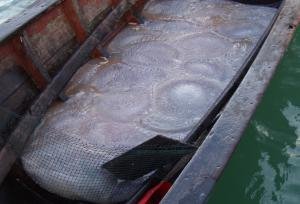
So we headed to Salak village, paddling upriver as the fishing fleet were heading the other way. It’s the jelly fish season at the moment and at various sites along the coastline near Kuching you’ll see small two-men fishing craft roaming the waters in search of jumbo-sized jelly fish. Santubong and Salak are good fishing grounds for jelly fish. The local fishermen catch the jelly fish with a big stick with a hook attached. The jelly fish sell for 50-80 sen a piece and each boat can catch 50-100 jelly fish on a good day. The jelly fish are then salted at village ‘factories’. Some of the product is sold locally but most of it is exported, mainly to Japan.

After watching some macaque monkeys in the mangroves and a brief rest stop at Salak village we headed back out to sea. It was not long before we encountered three groups of Irrawaddy dolphins. We just sat in the kayak, with FH20 occasionally performing an ‘Irrawaddy kayak spin’, slowly moving the kayak 360 degrees so we could see the groups all around us.

Off in the distance we saw a tourist boat watching another group of Irrawaddy dolphins. As we sat in the kayak looking towards the tourist boat both of us could not believe what we were witnessing - an appalling act of irresponsible tourism.

To be continued. Irresponsible Tourism in Action

Saturday, April 15, 2006

A brief history of Sarawak's dolphin watching industry

Sarawak was the first destination in Malaysia to offer commercial dolphin watching tours. These tours were launched in 1998 and as far as I am aware remain the only commercial dolphin watching tours in the country. Sarawak’s dolphin watching industry is focused on one species, the Irrawaddy dolphin. However, on rare occasions Indo-Pacific Humpback and bottlenose dolphins are seen on the tours.

CPH Travel, a Kuching-based tour operator, pioneered the development of dolphin watching tours in Sarawak. The tours were developed thanks to a chance meeting in Kuching. In 1997 Dr Thomas Jefferson, a marine mammal expert, contacted CPH Travel in order to rent a boat to look for dolphins at Santubong. At the time CPH offered marine tours and mangrove cruises in the Santubong area.

In June 1997 a 3-day survey of the waters around Santubong was conducted and groups of Irrawaddy dolphins were frequently sighted. The results of the dolphin survey were published in the December 1997 issue of the Sarawak Museum Journal.

Following the dolphin survey, Dr Jefferson suggested that CPH should develop a dolphin watching tour. After conducting further research and using the knowledge gained from the initial dolphin survey, CPH Travel launched its inaugural dolphin watching tour in 1998.

In 2001 Stuart Green and I conducted a dolphin survey in the waters around Santubong, Salak, Damai Beach, Telaga Air, Tunjung Sipang, Rambungan, Sempadi Island, Satang Island and Buntal. We rented a boat from Ehwan who had just started to offer mangrove cruises near his village of Buntal. As a former fisherman, Ehwan is a mine of information on where dolphins are found. Following our dolphin survey Ehwan also started to offer dolphin watching tours in the Buntal-Bako bay.

In 2005 approximately 1,500 people took part in dolphin watching tours in Sarawak. 90% of demand is from foreign tourists. The majority of these visited Santubong and Salak with dolphin watching pioneer CPH Travel. The rest went on tours of Buntal with Ehrwan or tours around Santubong with other operators.

Although still a small scale activity, demand for dolphin watching tours has grown over the last 2-3 years. Whilst the effects of tourism are relatively small when compared to the various threats faced by Irrawaddy dolphins, it is important to develop dolphin watching in a sustainable manner so that the animals are not disturbed. Worldwide it is recognised that the greatest concern with dolphin watching activities is in the start-up phase in new areas. Sarawak is in this start-up phase.

So far dolphin watching has been developed in a sustainable manner. The main dolphin watching operators know what they are doing and are careful when approaching the dolphins. They operate their tours in a responsible manner and use excellent ‘guides-cum-spotters’. These dolphin spotters come from the villages near to where the tours take place so community members derive some of the economic benefits from the tours. For example, CPH’s Jamadi, who hails from Buntal, has to be one of the best dolphin spotters around. He has unbelievable eyes and can spot dolphins and other wildlife that most guides will miss. It’s joy to go on a tour with someone as experienced as Jamadi as you get to see heaps of wildlife.

Other tour operators are now moving into the market (or considering doing so) and some of these operators are not very knowledgeable. At some point in the near future it will be necessary to develop dolphin watching guidelines and codes of conduct for Sarawak’s dolphin watching industry. Such guidelines are common elsewhere in the world.

More on this another day.