Showing posts with label trip reports. Show all posts

Thursday, May 22, 2008

Irrawaddy III and Finless Porpoises off Santubong


Last year CPH Travel purchased a new boat, the Irrawaddy III. It is a spacious vessel equipped with twin 250 hp, 4 stroke engines. This makes it ideal for trips offshore and great for wildlife watching trips as the engines are a lot quieter than the 2 stroke engines that other local tour operators use. CPH use the boat for dive groups, deep sea fishing trips and wildlife tours. I’ve been meaning to go out on this fantastic boat for a while.


On Wednesday I had the opportunity to take a trip on Irrawaddy III. The purpose of the trip was to look for dolphins in the Bako-Buntal Bay and a few offshore areas where the fishermen from Buntal often see dolphins. Jamadi, CPH’s boatman and keen eyed dolphin spotter, and Oscar from CPH joined our group.


We left the Santubong Jetty at 9 am and in no time at all arrived at the Bako-Buntal bay. Conditions were perfect for dolphin spotting with a calm sea, good visibility and a perfect blue sky above. After cruising around the Bako-Buntal Bay we headed out to the deeper waters offshore from Pulau Lakei and then backtracked to the fishing grounds and shipwrecks north of Tanjung Sipang. Despite the perfect conditions we did not see any dolphins. We were hoping to spot some bottlenose dolphins but it wasn’t to be. So we headed towards Satang Island and then on to Pulau Tukong Ara or bird rock to view the terns and hopefully spot some pacific reef egrets.


After a short while at bird rock we then headed towards the Santubong estuary and I spotted what looked like two dolphins splashing around on the surface. At first I thought they were Irrawaddy dolphins but they were tiny so I was a tad unsure. I was beginning to think that maybe I’d seen a turtle or a huge fish. Then they surfaced again and Oscar shouted “Finless Porpoises”. And sure enough to the side of the boat were a group of finless porpoises. The group were spread out and I estimate that they were a minimum of four individuals. They may well have been a whole lot more. Finless porpoises are very difficult to spot, they surface for a few seconds and the lack of dorsal fin makes it very difficult to track the group. After a 15-20 minutes we lost track of the group.


Spotting the finless porpoises was a fantastic experience. Every time I head out to the waters off Santubong I am amazed by what is there. The area is such a beautiful place. I love being there but I also get the feeling that I am witnessing something that is about to disappear. More on that another day.

Saturday, July 29, 2006

Colour Variation


In an article that appeared in the December 1997 issue of the Sarawak Museum Journal, Isabel Beasley and Thomas Jefferson noted that the colour of Irrawaddy dolphins in the Mahakam River in Kalimantan (Indonesia) was different from the colour of those found in north Borneo.

“The possibility of multiple stocks of Irrawaddy dolphins in Borneo seems high. Interestingly, Irrawaddy dolphins from the Mahakam River area appear to be very light, almost white in colour, while those observed along the north coast of Borneo have been consistently dark grey.”

The authors had conducted marine mammal surveys in Sabah and Sarawak, where the focused on rivers around Kuching. Whilst most of the dolphins sighted at Santubong, Salak and Buntal are dark grey, not all of them are. Groups of light grey dolphins are frequently sighted. It is not uncommon to see groups of both dark and light grey coloured Irrawaddy dolphins in the same area on the same day. The above picture was taken yesterday at Santubong where both dark and light grey dolphins were present in the estuary.

In their 1997 article Isabel Beasley and Thomas Jefferson pointed out that there were several areas where long term studies of dolphins in Borneo were feasible. They also highlighted the need to further investigate the conservation status of Irrawaddy dolphins in the Mahakam River. Since the article was published no in-depth long term study of Irrawaddy dolphins has been conducted in Sarawak. However, the Mahakam population in Kalimantan has been the subject of research, much of it done by Dr Danielle Kreb and her colleagues at the Yayasan Conservasi RASI, the Conservation Foundation for Rare Aquatic Species of Indonesia. For more information see the

Wednesday, July 12, 2006

50 Indo-pacific humpbacks offshore from Bako

On Friday 7th July a large group of around 50 indo-pacific humpback dolphins where spotted near Bako National Park. A group from the Malaysian Nature Society were in the area and had the pleasure of seeing the dolphins up close, surfacing near the boat with loud blows. I wish I was there. Indo-pacifics are occasionally spotted in nearshore waters near Kuching. They are more commonly seen in the dry season and sometimes enter rivers. Most sightings near Kuching are of small groups of less than 10 dolphins or lone individuals. For example groups have been spotted near Santubong and Muara Tebas and a lone individual was once spotted heading up the Santubong river towards the bridge.

Saturday, June 24, 2006

Video of large group of Irrawaddy dolphins at Santubong


As mentioned before it is not easy to get good photos or video of Irrawaddy dolphins. You need to spot a large group and hope that they hang around for a while. This is what happened on a recent trip to Santubong. We spotted one group very close to the shore and then a second group joined them. Before long dolphins were surfacing everywhere and I did not have a clue where to point the video camera. I tried to count the total number of dolphins around us but lost count after I got to 20. Where else in the world can you see 20+ Irrawaddy dolphins in the same stretch of the river? Santubong, it is such a magically place. Maybe one day the forests and shores at Santubong will become protected areas, as was first proposed over 20 years ago. I live in hope. But hope is not something that lasts forever, especially when every time I go dolphin watching I see those illegal sand dredgers in the bay. More on that another day.
Sunday, May 07, 2006

Wildlife Photography - Dolphins at Salak River

These images were taken by Ch’ien Lee, a professional photographer, who joined us for Saturday’s dolphin watching trip. Ch’ien Lee specialises in photographing rare plants and animals from the tropical rainforests of Borneo, Sumatra, New Guinea, and other locations in Southeast Asia. Check out Ch’ien Lee’s site at http://www.wildborneo.com.my/ for some excellent images of rare plants and wildlife from around Southeast Asian, including a range of photos from Sarawak.

Saturday, May 06, 2006

Dolphins & Happy Paddlers


This morning a group of us went out to the Salak River and had a wonderful interaction with a few groups of Irrawaddy dolphins. The dolphins seemed to be everywhere and I did not know which way to turn and point my camera.


And four happy paddlers were also there, grinning from ear to ear! Hope you enjoyed the day as much as we did Francis.

Pulau Tukong Ara - Bird Rock


Pulau Tukong Ara is a rocky outcrop located in the Santubong Bay, close to Satang Island. It was gazetted as a wildlife sanctuary in 1985 but later incorporated into the Talang-Satang National Park when this was created in 1999. The reason why the rock is protected is because it is inhabited by a breeding colony of Bridled Terns & Black Naped Terns.

A group of us went out there last week. I occasionally head out to the waters around Satang to see if there are any Bottlenose dolphins around. I haven’t been to Tukong Ara for a few years so was keen to have another look.

Whilst the terns were interesting, I was fascinated by the Pacific Reef Egrets that also make the rock their home. It is common to see various species of white coloured egrets all around the Kuching area. For a non-birder like me egrets are white. So when I first caught sight of two beautiful birds perched on Tukong Ara that looked like egrets but had a grey plumage I was a tad confused. Thankfully, a keen birder was part of our group and explained that it was a Pacific Reef Egret.

Birding in Malaysia is great resource on Sarawak's birdlife. And for some good shots of the Pacific Reef Egret check out Oriental Bird Images.
Categories: Sightings & Trip Reports_

Sunday, April 23, 2006

Kayaking to Salak Village


On Saturday FH20 and I went Kayaking with Irrawaddy dolphins again. Within five minutes of being on the water we spotted a small group of 3 dolphins swimming in the distance. However, they were roaming a large area and appeared to be searching for food. We let them be and decided to kayak to Kampung Salak, the Malay fishing village situated on Salak Island.

I’ve always enjoyed the Salak area. With its rich mangrove forests, wildlife and Malay fishing community, there’s always something going on in the river and heaps to see. OK, I’m usually there to see dolphins but sometimes I get distracted, forget the dolphins and soak up the other sights and sounds. When this happens I normally head to the Kuching Wetlands National Park, Sarawak’s first Ramsar site, and cruise the rivers and creeks in search of wildlife.

But this is not such a great idea when you are on a kayak. The Kuching Wetlands National Park is home to a relatively large population of crocodiles. I like kayaking with dolphins, I also like watching crocs but my preferred vehicle for croc watching is a sturdy boat.

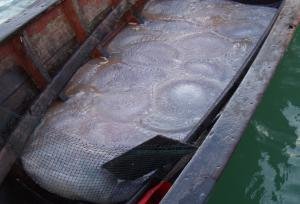
So we headed to Salak village, paddling upriver as the fishing fleet were heading the other way. It’s the jelly fish season at the moment and at various sites along the coastline near Kuching you’ll see small two-men fishing craft roaming the waters in search of jumbo-sized jelly fish. Santubong and Salak are good fishing grounds for jelly fish. The local fishermen catch the jelly fish with a big stick with a hook attached. The jelly fish sell for 50-80 sen a piece and each boat can catch 50-100 jelly fish on a good day. The jelly fish are then salted at village ‘factories’. Some of the product is sold locally but most of it is exported, mainly to Japan.

After watching some macaque monkeys in the mangroves and a brief rest stop at Salak village we headed back out to sea. It was not long before we encountered three groups of Irrawaddy dolphins. We just sat in the kayak, with FH20 occasionally performing an ‘Irrawaddy kayak spin’, slowly moving the kayak 360 degrees so we could see the groups all around us.

Off in the distance we saw a tourist boat watching another group of Irrawaddy dolphins. As we sat in the kayak looking towards the tourist boat both of us could not believe what we were witnessing - an appalling act of irresponsible tourism.

To be continued. Irresponsible Tourism in Action

Saturday, April 15, 2006

Another Irrawaddy dolphin breach

A couple of days ago I said that I’d only seen an Irrawaddy dolphin breach on three occasions. Make that four. I when out to Santubong with some friends from Kuching and KL on Easter Friday. Good trip, we saw four groups in total. The first group only consisted of two dolphins and we spotted them in the Santubong River itself, right near the Santubong bridge. They were light grey in colour. So just 1 minute into the trip and we saw dolphins. Not a bad start to the day.

We spotted the other groups in Santubong and Salak, all of them were dark grey/black. The different groups were dispersed around the estuary and did not come together as they did on Tuesday’s kayaking trip. Best of all we saw an Irrawaddy jump out of the water right in front of us, great little leap. It was not quite a full breach, more of a half-breach but most of us on the boat managed to see it.

Again the leap happened after the group we were watching had spent some time on the surface socialising and splashing around together. We spent an hour or so with the dolphins and then went wildlife watching in the Kuching Wetlands National Park.

We went on CPH Travels ‘Santubong Wildlife Tour’ and were not disappointed. Thanks to our guide Jamadi’s excellent skills at spotting wildlife we saw dolphins, long-tailed macaques, proboscis monkeys, silver-leaf monkeys, a stork billed kingfisher, fireflies and crocodiles. I’ll post on this another day.

Thursday, April 13, 2006

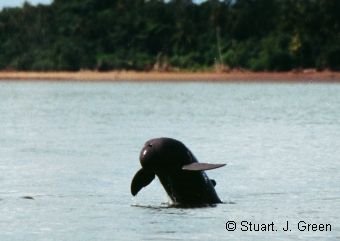
A full breach by the world's most chilled out dolphin


I don’t know what this dolphin had for lunch! The picture shows that the most inactive dolphins in the world do sometimes put on energetic displays. Here an Irrawaddy dolphin performs a full breach, jumping clear out of the water. The picture captures the early part of the jump. The photo was taken in the Santubong River estuary on 5th June 2001. At the time we were conducting a dolphin survey. I’ve only seen this breaching behaviour three times in the 6 years that I have been going out dolphin watching near Kuching.

On that day we were watching a group of dolphins that had come together on the surface. They were splashing around, slapping their fins at each and generally seemed to be enjoying themselves. I don’t know what they were doing – playing, mating - who knows. They were on the surface for about 20 minutes, then the main group slowly moved off and suddenly a dolphin jumped out of the water right near the boat. I have not seen another photo of an Irrawaddy dolphin breaching in the wild. So, thanks Stuart for allowing me to post it here.

Wednesday, April 12, 2006

Kayaking with Irrawaddy dolphins


What an amazing experience. I did not think we could pull it off but we did. A couple of months back, thanks to Kenny, I came across FH20’s Kuching Kayak. The first thing that struck me was that FH20 hangs out in the same rivers and estuaries that I do. He paddles a kayak whilst I sit in a boat and watch dolphins, but both of us enjoy the same rivers, creeks and estuaries. And both of us have somewhat obscure hobbies.

It took me all of 2 seconds to realise what I wanted to do - combine our hobbies and go kayaking with Irrawaddy dolphins. From reading his blog I knew FH20 would be up for it. Thing is we needed the weather on our side but this year’s wet season has dragged on for ever. So things were put on hold, until yesterday.

And it was worth the wait. My first dolphin watching trip of 2006 was one of the best dolphin watching trips I’ve ever had in Sarawak. Sitting in a kayak, bobbing around the Salak River, with Irrawaddy dolphins popping up all around the kayak, is dolphin watching heaven.

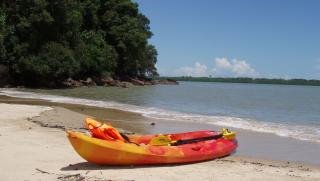
Four of us went on the trip, myself, FH20, Kenny and Peggy who works for WCS, an environmental NGO. We set off around 9 am from a small beach near Pasir Panjang and headed out to the mouth of the Santubong River where all the fishing boats were congregating. The fish were obviously there so maybe the dolphins were too. I asked a fisherman if he had seen any “pesut” and he said that they were near the other fishing boats. The boats were some distance away and we were about to head to a nearby beach when Peggy spotted a small group of dolphins heading towards us. They where heading upriver so we followed them into the Salak River, keeping our distance so as not to disturb them.

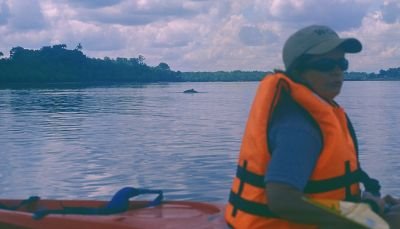
I was on a double kayak with FH20 so he did most of the paddling while I tried to get some shots. We ended up near Salak Island where more groups of dolphins started to appear. There were 4 or 5 groups of dolphins in the river. It was quite difficult to tell exactly how many groups there were as dolphins were surfacing all over the place.

As the dolphins were all round we just stopped in one area and the dolphins swam towards us. Being in a kayak, instead of a boat, offers a totally different dolphin watching experience from what I’m used to. For a start you are on the surface of the water rather than a few metres above the water so you get a real different take on things. The “blow” of the dolphins is also much loader as you are closer to the water.

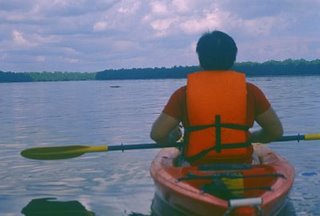
And you can get close, or more to the point the dolphins get close to you. I was a bit concerned about how to approach the dolphins in a kayak; I didn’t want to harass them so we paddled parallel to the dolphins, keeping our distance. The beauty of being in a kayak is that once you get near the dolphins, you can just stop paddling and let the dolphins come to you. There is no propeller noise, just silence and after a while the dolphins start to come closer to the kayak.

At the time I thought this would mean I’d get some great photos. But trying to photo an Irrawaddy dolphin from a kayak is not easy. When you watch dolphins from a boat you can move around the boat to take photos if the dolphins surface behind you or to your side. I tried to do this on the kayak, by twisting my body to the side to photograph the dolphins. Big mistake, FH20 quickly said ‘no, you’ll topple us over’. I didn’t think of that, I was too excited.

We were pretty lucky to see so many dolphins, maybe 20-25 in total, all swimming around in the same section of the river. To be able to kayak with them was great. What an amazing day on the river.