Showing posts with label threats. Show all posts

Friday, August 11, 2006

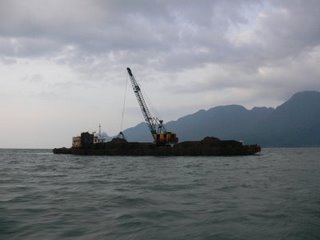
Sand Dredgers at Santubong


Question: What do sand dredging barges and Irrawaddy dolphins have in common?

Answer: Both are currently found at the mouth of the Santubong River.

Whilst the dolphins have been around for years, the sand dredging barges are a relatively recent arrival. Over the last few months they have been extracting sand in waters near Santubong. If you go out dolphin watching you are bound to see them. Unlike the shy Irrawaddy dolphins the barges are easy to spot. They are commonly found in the middle of the estuary, off Damai Beach and near Satang Island which is part of the Talang-Satang National Park. Whilst sightings of dredging barges are more common during the day, the barges are also active at night.

It is not the first time that sand dredgers have appeared in the Santubong area. In 2005 dredging operations were discovered within the Kuching Wetlands National Park, Sarawak’s first Ramsar site. Trees had been cleared and a jetty had been built to facilitate the dredging operation. Thankfully the relevant authorities acted and the dredging operations within the Kuching Wetlands were stopped.

Wednesday, July 12, 2006

More dolphin by-catch


Unfortunately another Irrawaddy dolphin was accidentally caught in fishing nets near Kuching last month. This time it was a new born calf, less than a metre long. As you can see from the photo it was tiny. Usual story, the fisherman hauled in his nets and found the dolphin which had already drowned. As I’ve mentioned before the true scale of dolphin by-catch in Sarawak waters is not known as the relevant wildlife agency does not monitor the situation or encourage fishermen to report cases of incidental catch. Research carried out a few years ago in the Kuching Division suggests that 2-3 dolphins are caught each year in villages located near known dolphin populations. The informal reports I get suggest that the figure is often higher, although numbers fluctuate from year to year.

Sunday, April 23, 2006

Irresponsible Tourism in Action


As I’ve mentioned before, a number of ‘copy-cat’ operators have started to offer dolphin watching tours at Santubong and many of these are not very knowledgeable. I’d heard about a blue boat that regularly harasses the dolphins, chasing them around the bay.

On Saturday 22nd April after kayaking to Salak village, FH20 and I paddled back to the river estuary and encountered three groups of Irrawaddy dolphins. We stopped paddling and just sat in the kayak watching the dolphins surface nearby.

We then spotted a tourist boat some distance away watching another group of dolphins. Both of us were shocked at what we saw. It was the infamous blue boat, the very same boat that responsible dolphin watching operators have expressed concern about.

I could not believe what this boat was doing. The boatman was driving the boat directly towards the group, not parallel to the group, but straight towards the direction the group was swimming. This action split the group up and they moved on, surfacing some distance away from the boat. The boatman then repeated the action, moving at speed towards the group and splitting the group up again. The boat was clearing disturbing the dolphins.

As the boat was off in the distance there was nothing we could do so we carried on watching the groups near us and hoped the boat would not come near us. We remained in the same spot in the river with the three groups surfacing around us. Three dolphins swam towards the kayak and passed just metres away. Another group were socialising on the surface of the water 30 metres away. The different groups then came together in the same area and we just sat there enjoying the experience. But it wasn’t to last.

We heard the loud noise of a boat approaching at speed. We turned around and saw the blue boat speeding towards the group of dolphins which were now 40 metres from our kayak. We were livid as we watched the boat motor towards the group of dolphins. We shouted to the boatman to slow down and keep its distance but the boat drove straight into the combined group. The three groups of dolphins that had come together to socialise on the surface quickly dived and fled.

By this time we had enough, so we paddled over to the boat to politely ask the boatman to stop harassing dolphins and give him a bit of advice on how he should approach the dolphins. Maybe he’d then stop disturbing the dolphins and the tourists could also enjoy a better experience.

But the boatman would not listen to us and said that he knew what he was doing. So we give him a piece of our mind and asked the tourists if they knew what they had just been part of. The tourists kept quiet. They probably thought we were a couple of nutters. The boat then left and headed towards the Kuching Wetlands National Park. With the bad ‘Chi’ in the air we paddled back to shore.

If Sarawak is to have a sustainable dolphin watching industry, all boat operators need to behave in a responsible manner and put the dolphins first. Tourists also need to play their part. If they experience such behaviour they should ask their boatman to stop chasing the dolphins and report the operator. Better still don’t go out on a tour with an inexperienced operator. But in the long run the only solution will be the establishment of dolphin watching guidelines and proper training for inexperienced boatmen.

Friday, April 21, 2006

Dolphin bycatch in one village near Kuching

Perhaps the single largest threat to the Irrawaddy dolphins in Sarawak is by-catch, when fishermen accidentally catch dolphins in their nets. In Sarawak, fishermen will release a dolphin if it is found alive in their fishing nets. They will cut the nets to free the dolphin regardless of the cost they incur in damaged nets. I’ve spoken to many fishermen, young and old, that have done this. They say that the dolphins often appear as though they are crying and for years their tradition has been to release the dolphins so that is what they do.

But on many occasions dolphins are found dead in the nets. If this is the case the fishermen will take the dolphin back to their village and eat the meat, usually distributing it to family and friends in the village. On occasions the meat is sold. Their approach is ‘well its dead already so why waste it’. Some people may have a problem with this but it’s a fact of life in the coastal villages around Sarawak. If dolphins are found alive in the nets they are released, if they are already dead then nothing is wasted.

There is no monitoring of dolphin by-catch in Sarawak. So when dolphins are caught there is no system in place for the fishermen to report the death. As such the relevant wildlife agency does not record the number of fatalities and does not examine the dolphin carcasses.

So how bad is the problem of dolphin by-catch in Sarawak? No one really knows for sure. Interviews with residents of fishing villages in the Kuching division suggest that 2-3 dolphins are caught every year in each of the villages surveyed (Jaaman et al, 2000). Information I collected in 2002 and 2003 is also in line with this estimate.

In 2002 and 2003 I kept track of the number of cases of incidental dolphin catch by the fishing fleet of one village near Kuching. Fishing boats from this village fish in both offshore and near shore waters. Four dolphins were accidentally caught in fishing nets in 2002 and three dolphins in 2003. Of these seven bycatches, four were confirmed to be Irrawaddy dolphins.

In March 2002, two dolphins were caught in offshore waters, species not known but the dolphins were described as having long beaks. The fishermen found the dead dolphins in the morning after a heavy storm the night before. In the last week of April 2002, one dolphin was caught near Satang Island. The fishermen believed this was an Indo-Pacific Hump-back (or “white dolphin” as local fishermen call this species). The dolphin was dead in the nets when the fishermen found it.
On the morning of 8th May 2002 a juvenile Irrawaddy was accidentally caught in the middle of the Bako-Buntal bay. The dolphin was found dead when the fisherman hauled in his nets. The dolphin was brought back to the village and the meat consumed. I arrived in the village later on that day to see if anything remained. The dolphin had already been cut up and all that remained was the head and tail.

On 4th May 2003 three Irrawaddy dolphins (one fully grown adult and two smaller dolphins) were caught in nets between Tanjung Sipang and Pulau Lakei, near Bako National Park. The dolphins were dead when found and the meat was later sold in the village.

Pictured below is the remains of the juvenile Irrawaddy that was caught in 2002. Not a pretty sight. So what is the impact of by-catch on Sarawak’s population of Irrawaddy dolphins? No one knows. But one thing I do know is that some sort of monitoring system needs to be set up to ascertain how bad the problem is.


Reference

Jaaman, S.A., Ali, S.A., Anyi, Y.U.L., Miji, C. J., Bali, J., Regip, J.M., Bilang, R. and Wahed, R., 2000. Research and conservation of marine mammals in Sarawak: current knowledge. Hornbill 4: 17-28. Forest Department Sarawak, Kuching.


Saturday, March 25, 2006

Propeller Strike

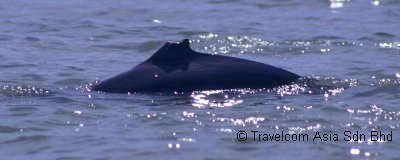
This photo was taken at the Santubong estuary. It shows a chunk cut out of the dolphin’s dorsal fin. There’s a high volume of boat traffic in the rivers and estuaries around Kuching with fishing fleets and pleasure craft constantly coming and going. Not surprisingly dolphins often get hit by boat propellers. It is quite common to spot Irrawaddy dolphins with chunks cut out of their dorsal fins. I’ve seen dolphins with half a dorsal fin, no dorsal fin at all, and circular cuts on the upper body that look like they have been carved out by a boat propeller.