Monday, August 21, 2006

Job Vacancy for Researchers?


Just kidding, no jobs here I’m afraid. Apologises to any job seekers who googled there way here. Back button time for you and good luck with you endeavours. This meandering post is about the need for research on Sarawak’s Irrawaddy dolphins.

A number of studies of Irrawaddy dolphins have been conducted in various countries in Southeast Asia and population estimates have been made for these sites. Here are a few stats to ponder.

Indonesia, Mahakam River, population estimated at 70 individuals based on a 2005 survey. For more info see YK-RASI

Ayeyarwady River, Myanmar, population estimated at 59 individuals based on a 2003 surevy. For more info see IUCN

Malampaya Sound, Palawan, Philippines, population estimated at 77 individuals based on a 2001. For more info see IUCN

Songkhla Lake, Thailand, population now extremely low, fewer than 50. For more info see IUCN

Mekong River, Cambodia, best estimate is 69 based on 2003 survey. For more info see IUCN

Yeah, I know, the above numbers make for pretty depressing reading. At each of the sites surveyed the population is between 50-80 individuals. It doesn’t take a rocket scientist to work out that Southeast Asia’s Irrawaddy dolphins need all the help they can get. The first step in that process is to understand what is going on. To determine conservation priorities you need to conduct scientific research, estimate the population, examine threats, etc. This is already happening elsewhere in Southeast Asia with research being conducted in Cambodia, Indonesia, Thailand, Myanmar and the Philippines. Another project to is about to begin in Indonesia at Sembilang National Park.

So, how about Sarawak? What is the dolphin population in the Kuching area? Sorry folks, at present no one has a clue. Whilst one-off dolphin surveys have been conducted in Sarawak, these just show that there are dolphins out there. Whilst this is a welcome start, follow-up work is needed. Ideally a long term study, or for starters a preliminary study to estimate the dolphin population around Kuching and perhaps some outreach work with fishing communities so that a bycatch monitoring system can be set up in key villages.

So far the local scientific community, the wildlife agency and NGOs have largely ignored Sarawak’s Irrawaddy dolphins. In many ways this is not surprising; after all there are enough issues to look at on land in Sarawak, let alone looking out to sea.

But looking out to sea can be rewarding, especially when there are dolphins on your doorstep.

The fact that relatively large numbers (25+) of Irrawaddy dolphins have been sighted in the Santubong area and groups are regularly sighted at Buntal, Muara Tebas and other rivers and estuaries close to Kuching, suggests that there could be a significant population near Kuching. I am no marine mammal expert - I just like dolphin watching - so I can not say how significant these sightings are.

But when I look at the population stats from elsewhere in the region, 59 in the Ayeyarwady, 77 in the Malampaya Sound, 70 in the Mahakam, etc., it gets me thinking. It makes me think how lucky I am to be able to see four or five groups of Irrawaddy dolphins in one day. It makes me wonder how many dolphins there are near Kuching. It makes me think that maybe, just maybe, the population around Kuching could be pretty significant. It also makes me think - where are the folks with binoculars and clipboards. It sure would be nice to see some researchers out in the bay observing the dolphins instead of just fishermen, tourists and the odd bridled tern.

In many ways the tourism industry has put Sarawak’s Irrawaddy dolphins in the public eye. More and more people are aware that dolphins are found near Kuching and this increased awareness has to be a good thing. What is required now is an increase in scientific knowledge.

In 2000 the Sarawak Forest Department conducted a marine mammal survey along the coast of Sarawak in collaboration with the Borneo Marine Research Institute at the University Malaysia Sabah. The results of the 2000 survey were published in ‘Hornbill’, a Forest Department publication. This is what the researchers recommended.

“Irrawaddy dolphins and finless porpoises in coastal waters, estuaries and rivers of Sarawak should be given serious attention. The creation of reserves for the protection and management of dolphins is strongly encouraged…The impact of incidental catches of dolphins should be investigated…Further studies on the populations, behaviour and ecology of inshore cetaceans should be conducted.”

Some sound recommendations. Unfortunately, six years on, no in-depth ‘further studies’ have been conducted. No serious attention has been given. The impact of bycatch has not been investigated and no dolphin reserves have been set up.

If the Irrawaddy dolphin population around Kuching is significant, and without the data, that is a big if, then Sarawak has an opportunity to play an important role in the conservation of Irrawaddy dolphins in Southeast Asia. But for this to happen research needs to be conducted and more attention needs to be given to the dolphins on the doorstep of Kuching.

Monday, August 14, 2006

MP calls for probe into dredging

The Member of Parliament for Santubong, Datuk Wan Junaidi Tunaku Jaafar, has called for the relevant agencies to investigate the dredging operations at Santubong. This was front page news in Sunday’s edition of the Eastern Times under the headline “Probe illegal sand dredging call”.

The MP was quoted in the local daily as saying “I am concerned about such illegal activities because they affect the livelihood of the people, especially the fishermen in the area”. For some time now the local fishermen have been complaining about the sand barges and reduced fish catch. A number of press reports have highlighted the fishermen’s concerns.

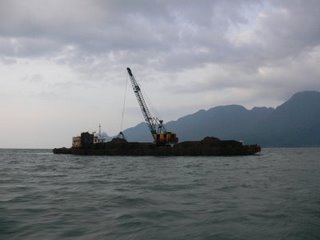
According to the Eastern Times report, the villagers say the barges move in between 10 and 11 pm and work through the night. On a number of occasions whilst dolphin watching at Santubong I’ve seen the barges during the day. The photo in the previous post ‘Sand dredgers at Santubong’ was taken around 6.30 pm. On that day two barges were dredging for sand when we arrived in the area just after lunch.

I went out dolphin watching again on Sunday afternoon and there was one dredging barge in the Santubong estuary. It was not dredging for sand when we saw it. It was anchored with a second tug boat nearby. There was also a ‘pod’ of four dredging barges in the Santubong River itself, moored just past the junction where the Buntal River joins the Santubong River. Looks like the brazen barges could be breeding! Well maybe not, but it does appear that Santubong’s barge population is increasing with the pod size now ranging from 1-4 individuals. If the barge population continues to increase there could be more sand dredging barges than dolphins at Santubong!

Now that somewhat flippant last remark is not as stupid as it sounds. Both the fishermen and the dolphins fish in the same waters off Santubong. These two groups of Santubong residents have lived side by side for generations with enough fish for both the villagers and the dolphins. The arrival of the sand dredgers has impacted the livelihood of the fisher folk, that we do know. But we do not know what impact the dredging operations are having on the dolphins.

So it is good to hear that the Santubong MP has called for a probe into the dredging and is highlighting the concerns of his constituents. By helping the fishermen Datuk Wan Junaidi is helping the dolphins of Santubong.

Friday, August 11, 2006

Sand Dredgers at Santubong


Question: What do sand dredging barges and Irrawaddy dolphins have in common?

Answer: Both are currently found at the mouth of the Santubong River.

Whilst the dolphins have been around for years, the sand dredging barges are a relatively recent arrival. Over the last few months they have been extracting sand in waters near Santubong. If you go out dolphin watching you are bound to see them. Unlike the shy Irrawaddy dolphins the barges are easy to spot. They are commonly found in the middle of the estuary, off Damai Beach and near Satang Island which is part of the Talang-Satang National Park. Whilst sightings of dredging barges are more common during the day, the barges are also active at night.

It is not the first time that sand dredgers have appeared in the Santubong area. In 2005 dredging operations were discovered within the Kuching Wetlands National Park, Sarawak’s first Ramsar site. Trees had been cleared and a jetty had been built to facilitate the dredging operation. Thankfully the relevant authorities acted and the dredging operations within the Kuching Wetlands were stopped.

Saturday, July 29, 2006

Colour Variation


In an article that appeared in the December 1997 issue of the Sarawak Museum Journal, Isabel Beasley and Thomas Jefferson noted that the colour of Irrawaddy dolphins in the Mahakam River in Kalimantan (Indonesia) was different from the colour of those found in north Borneo.

“The possibility of multiple stocks of Irrawaddy dolphins in Borneo seems high. Interestingly, Irrawaddy dolphins from the Mahakam River area appear to be very light, almost white in colour, while those observed along the north coast of Borneo have been consistently dark grey.”

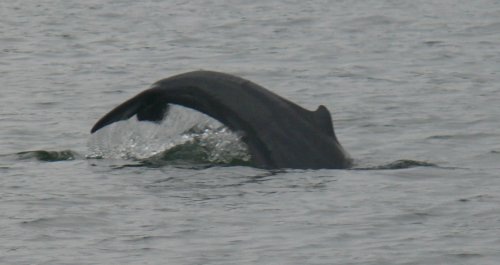
The authors had conducted marine mammal surveys in Sabah and Sarawak, where the focused on rivers around Kuching. Whilst most of the dolphins sighted at Santubong, Salak and Buntal are dark grey, not all of them are. Groups of light grey dolphins are frequently sighted. It is not uncommon to see groups of both dark and light grey coloured Irrawaddy dolphins in the same area on the same day. The above picture was taken yesterday at Santubong where both dark and light grey dolphins were present in the estuary.

In their 1997 article Isabel Beasley and Thomas Jefferson pointed out that there were several areas where long term studies of dolphins in Borneo were feasible. They also highlighted the need to further investigate the conservation status of Irrawaddy dolphins in the Mahakam River. Since the article was published no in-depth long term study of Irrawaddy dolphins has been conducted in Sarawak. However, the Mahakam population in Kalimantan has been the subject of research, much of it done by Dr Danielle Kreb and her colleagues at the Yayasan Conservasi RASI, the Conservation Foundation for Rare Aquatic Species of Indonesia. For more information see the

Saturday, July 15, 2006

New Pamphlet on Sarawak's Irrawaddy Dolphins


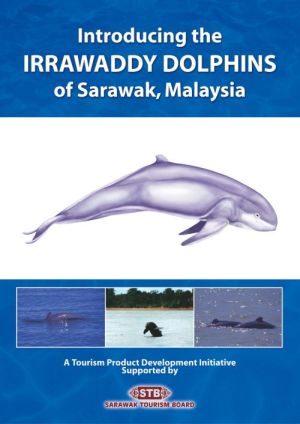
The Sarawak Tourism Board recently published a pamphlet on Sarawak’s Irrawaddy dolphins as part of a product development initiative related to the state’s dolphin watching industry. The pamphlet will be given out to tourists who participate in dolphin watching tours. It contains a fact file on the Irrawaddy dolphin with information on habitat, distribution, appearance, behaviour, diet, reproduction, group size, and an overview of the various conservation threats faced by the dolphins. It also discusses association with local fisherman, where to go dolphin watching and provides brief details about other marine mammals of Sarawak. The general idea is to improve on-board interpretation so that tourists can learn more about the dolphins.

The pamphlet also contains a range of photos taken at Santubong, Salak, Sibu Laut and Buntal. Many of these photos first appeared in this blog. The back page image by Chien Lee was featured here in May.
So, if you are in town and plan to go dolphin watching ask for a copy of the pamphlet.

Wednesday, July 12, 2006

More dolphin by-catch


Unfortunately another Irrawaddy dolphin was accidentally caught in fishing nets near Kuching last month. This time it was a new born calf, less than a metre long. As you can see from the photo it was tiny. Usual story, the fisherman hauled in his nets and found the dolphin which had already drowned. As I’ve mentioned before the true scale of dolphin by-catch in Sarawak waters is not known as the relevant wildlife agency does not monitor the situation or encourage fishermen to report cases of incidental catch. Research carried out a few years ago in the Kuching Division suggests that 2-3 dolphins are caught each year in villages located near known dolphin populations. The informal reports I get suggest that the figure is often higher, although numbers fluctuate from year to year.

50 Indo-pacific humpbacks offshore from Bako

On Friday 7th July a large group of around 50 indo-pacific humpback dolphins where spotted near Bako National Park. A group from the Malaysian Nature Society were in the area and had the pleasure of seeing the dolphins up close, surfacing near the boat with loud blows. I wish I was there. Indo-pacifics are occasionally spotted in nearshore waters near Kuching. They are more commonly seen in the dry season and sometimes enter rivers. Most sightings near Kuching are of small groups of less than 10 dolphins or lone individuals. For example groups have been spotted near Santubong and Muara Tebas and a lone individual was once spotted heading up the Santubong river towards the bridge.